

You’ve probably heard it a hundred times: “Just do your Kegels.”
Whether this is after having a baby, when things feel “off” down there, or honestly… just because you’re a woman and someone told you this is what you need as you age.
But here’s the thing—Kegels aren’t always the answer. And in some cases? They can actually make things worse.
Let’s talk about what your pelvic floor actually needs—because it’s a lot more nuanced than just squeezing and hoping for the best.
What Are Kegels, Really?
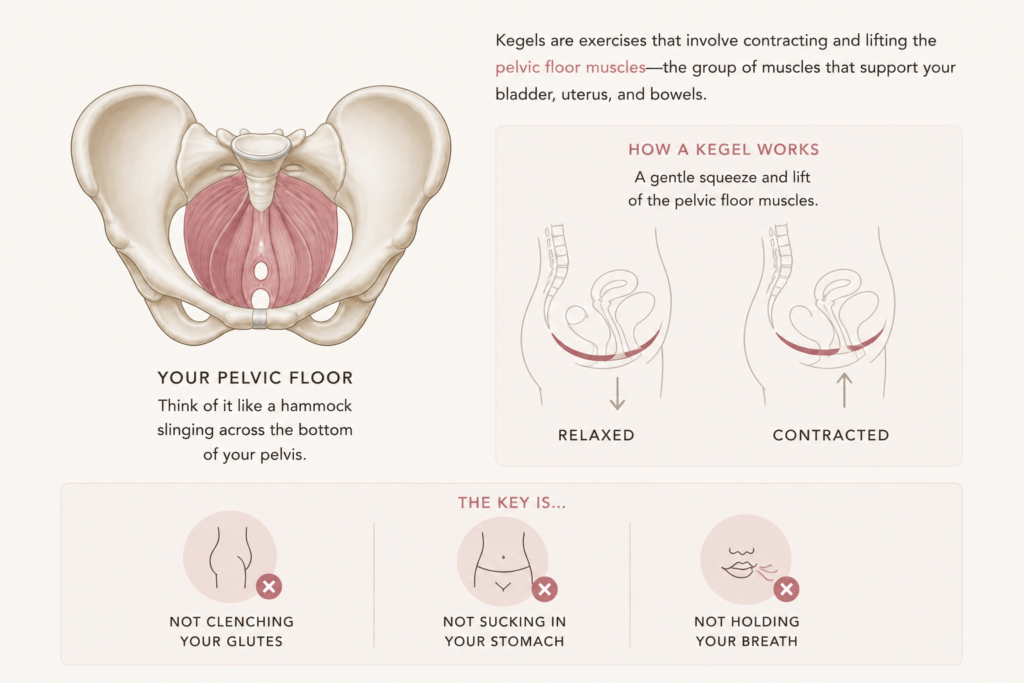
Kegels are exercises that involve contracting and lifting the pelvic floor muscles—the group of muscles that support your bladder, uterus, and bowels.
Think of it as:
- Lifting a hammock inside your pelvis
- Not clenching your glutes
- Not holding your breath
This might sound simple in theory… but often it’s done incorrectly.
The Problem: Kegels Became a Blanket Recommendation
For years, Kegels have been handed out like a one-size-fits-all solution for:
- Leaking
- Postpartum recovery
- Core weakness
- “Tightening”
But your pelvic floor isn’t just about strength—it’s about balance.
When Kegels Can Help
Kegels can be beneficial if your pelvic floor is:
- Weak
- Underactive
- Lacking coordination
You might benefit if you notice:
- Leaking when you cough, sneeze, or exercise
- A feeling of heaviness or lack of support
- Difficulty holding in gas
In these cases, strengthening can be helpful—but only when done correctly.
When Kegels Can Make Things Worse
Here’s the part most people never hear:
If your pelvic floor is already tight or overactive, doing Kegels is like tightening an already clenched fist.
This can lead to:
- Pain with intimacy
- Difficulty inserting tampons
- Constipation
- Persistent core or back tension
- That “always bracing” feeling
In these cases, your body doesn’t need more tightening—it needs relaxation and coordination.
If You’re Unsure—Don’t Guess
Symptoms like leaking, pain, or core weakness can come from both a weak or overactive pelvic floor—and the solutions for each are very different.
The solutions for each are very different.
That’s why it’s always recommended to work with a pelvic floor physical therapist if you can.
They can assess your muscle function, coordination, and tension levels to help you do the right kind of work for your body.
Your Pelvic Floor Is Meant to Move
Your pelvic floor isn’t supposed to stay contracted all day.
It should:
- Lengthen when you inhale
- Gently lift when you exhale
This natural movement is what supports your core—not constant squeezing.
Try This: A Simple Pelvic Floor + Breath Exercise
If you’re not sure where to start, this is one of the most powerful (and underrated) things you can do.
- Step 1: Get into a comfortable position
- Lie on your back with your knees bent, or sit upright with your feet flat on the floor.
- Step 2: Inhale slowly through your nose
- Let your ribcage expand in all directions—front, sides, and back.
- Think: gentle expansion, not forcing your belly out.
- As you inhale, allow your pelvic floor to soften and lengthen.
- Step 3: Exhale slowly through your mouth
- Let your ribs come back in.
- Gently feel your pelvic floor lift—without clenching or squeezing hard.
- Step 4: Repeat for 5–8 breaths
- Slow, controlled, and relaxed.
What this should feel like:
- No tension in your glutes, thighs, or jaw
- No forceful pushing or gripping
- A subtle, natural movement—not a hard contraction
Pro tip:
If you feel yourself constantly “holding in” your stomach during the day, this exercise can help reset that pattern.
The Real Goal: Connection > Clenching
Instead of asking, “Should I be doing Kegels?”
A better question is:
Can I fully relax my pelvic floor?
Can I coordinate it with my breath?
Because true strength comes from:
- Control
- Awareness
- Timing
Not just repetition.
What To Do Instead (For Most Women)
If you’re not sure where you fall, start here:
- Focus on deep breathing (360 breathing)
- Let your pelvic floor fully relax on inhale
- Avoid constant “sucking in” or bracing
- Pay attention to tension in your body
From there, you can layer in strengthening if your body actually needs it.
Bottom Line
Kegels aren’t bad for you. They’re just not always the answer for every woman, and definitely not a blanket treatment.
Your body doesn’t need a one-size-fits-all fix—
it needs the right kind of support.
Closing
If you’ve ever been told to “just do Kegels” and something still felt off… you’re not alone.
Learning how your body actually works is the first step toward feeling strong, supported, and at home in it again.